
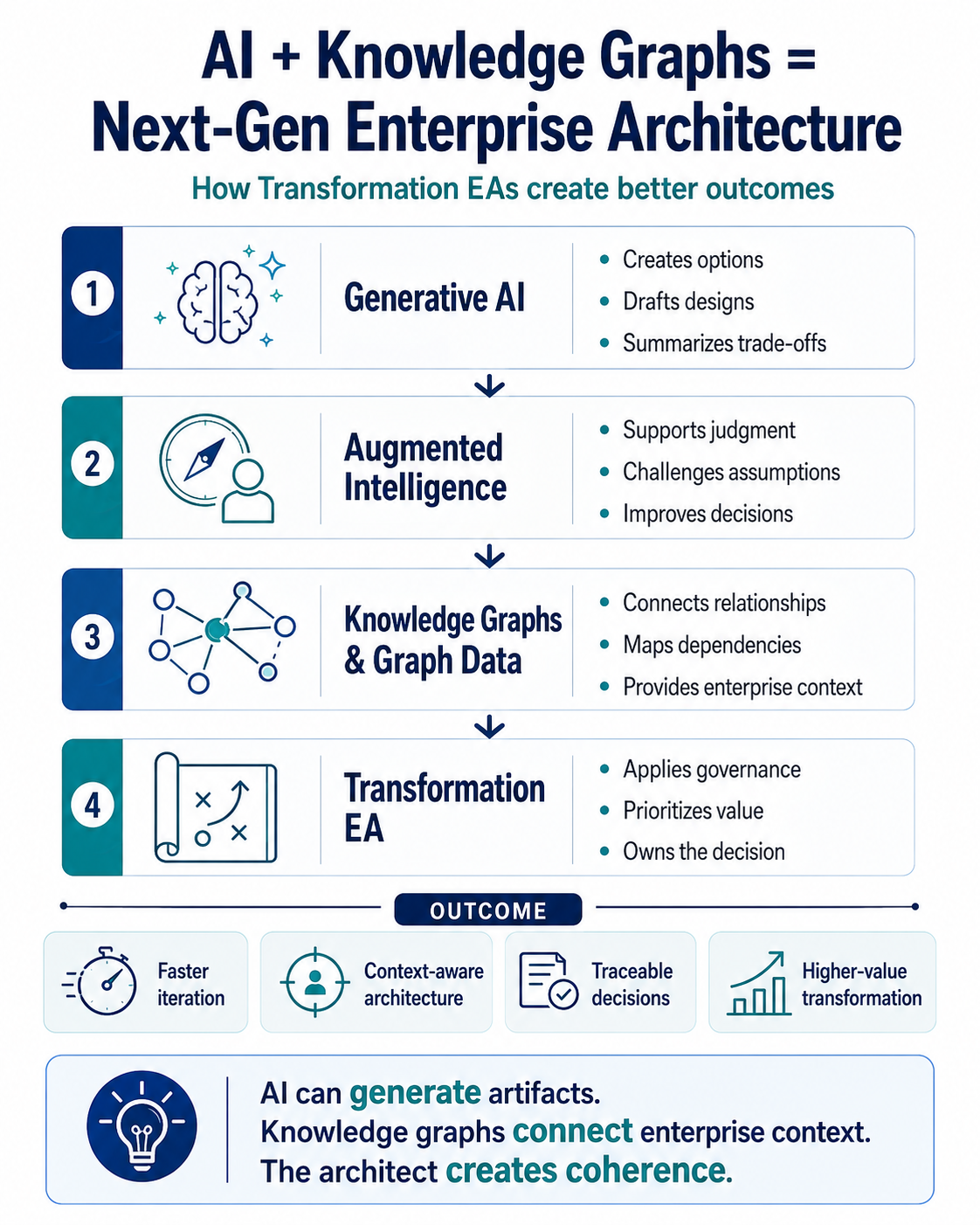
Enterprise Architecture has always been more than diagrams. At its best, EA connects business goals, operating models, applications, data, platforms, risks, controls, people, and transformation roadmaps into one coherent direction.
Now AI is changing the discipline. But the real opportunity is not simply using generative AI to produce architecture diagrams, documentation, or design options faster.
The bigger opportunity is combining Generative AI for creation, Augmented Intelligence for decision support, Knowledge Graphs for enterprise context, and Enterprise Architects for judgment, governance, and accountability.
Why this matters
Most enterprise complexity does not live inside one system. It lives in the relationships between systems: which applications depend on which data, which processes rely on which platforms, which teams own which capabilities, and which controls affect which assets.
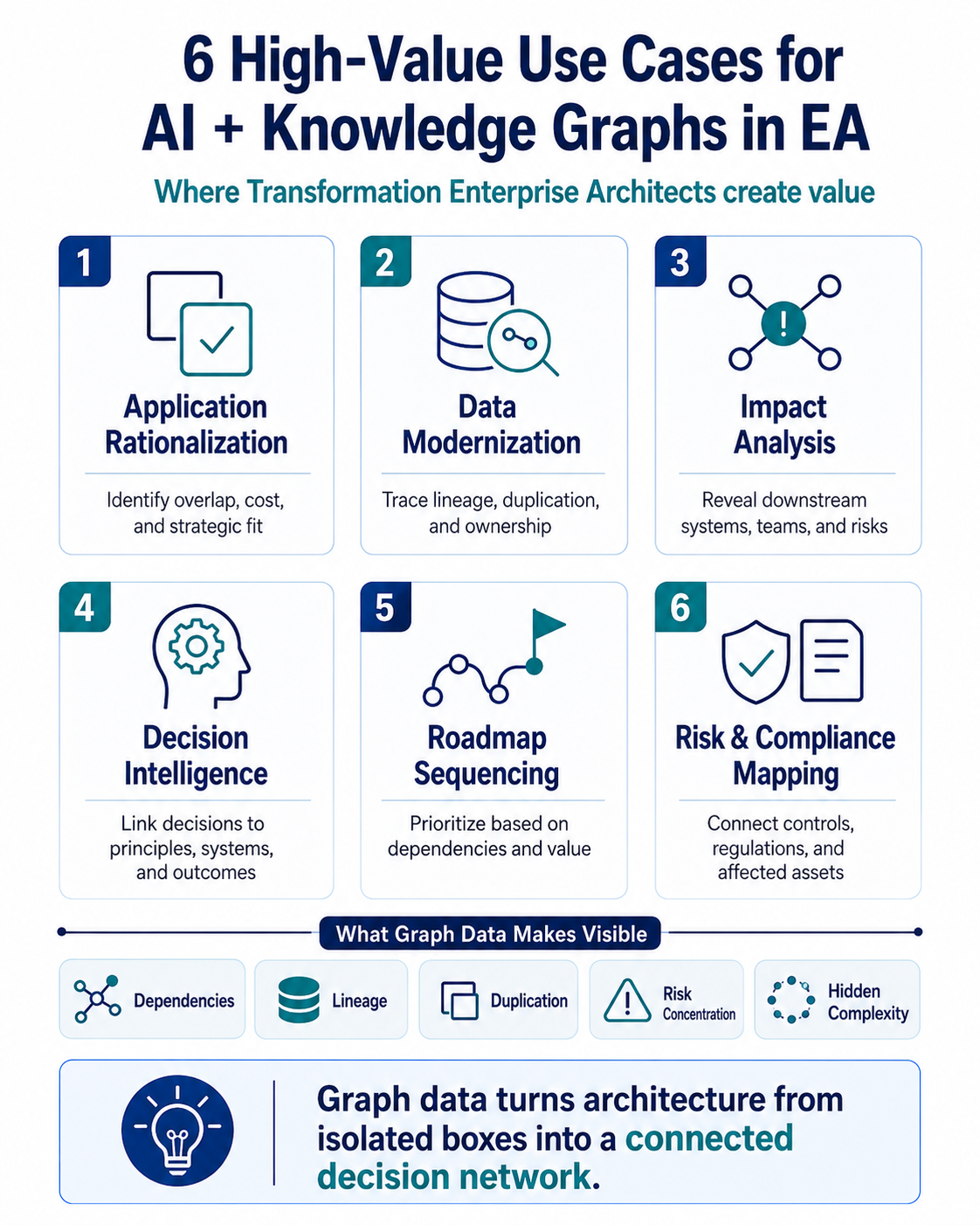
This is where graph data changes the game. A knowledge graph makes those relationships visible. It turns architecture from isolated boxes into a connected decision network.
Six high-value use cases
Application rationalization
Identify overlap, cost, ownership, and strategic fit across the portfolio.
Data modernization
Trace lineage, duplication, ownership, and modernization dependencies.
Impact analysis
Reveal downstream systems, teams, processes, and risks before changes are made.
Decision intelligence
Link decisions to principles, systems, outcomes, risks, and trade-offs.
Roadmap sequencing
Prioritize change based on dependencies, value, feasibility, and business urgency.
Risk and compliance mapping
Connect controls, regulations, accountable owners, and affected assets.
AI can generate artifacts. Knowledge graphs connect enterprise context. The architect creates coherence.
From traditional EA to graph-powered EA
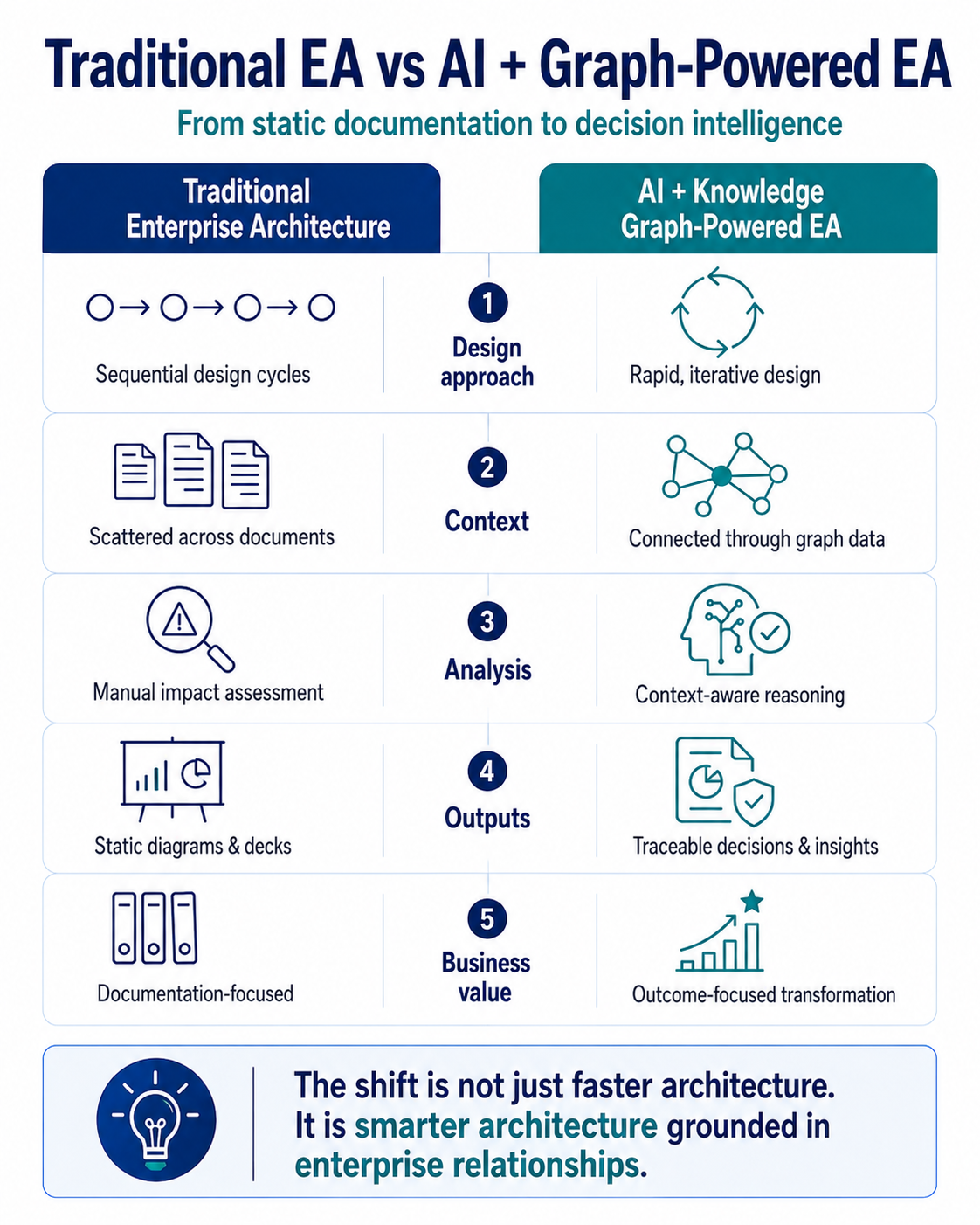
Traditional EA often becomes documentation-heavy: sequential design cycles, scattered documents, manual impact assessments, static diagrams, and limited traceability to business outcomes.
AI and graph-powered EA shifts the discipline toward rapid iterative design, connected context, context-aware reasoning, traceable decisions, and outcome-focused transformation.
Benefits, risks, and guardrails
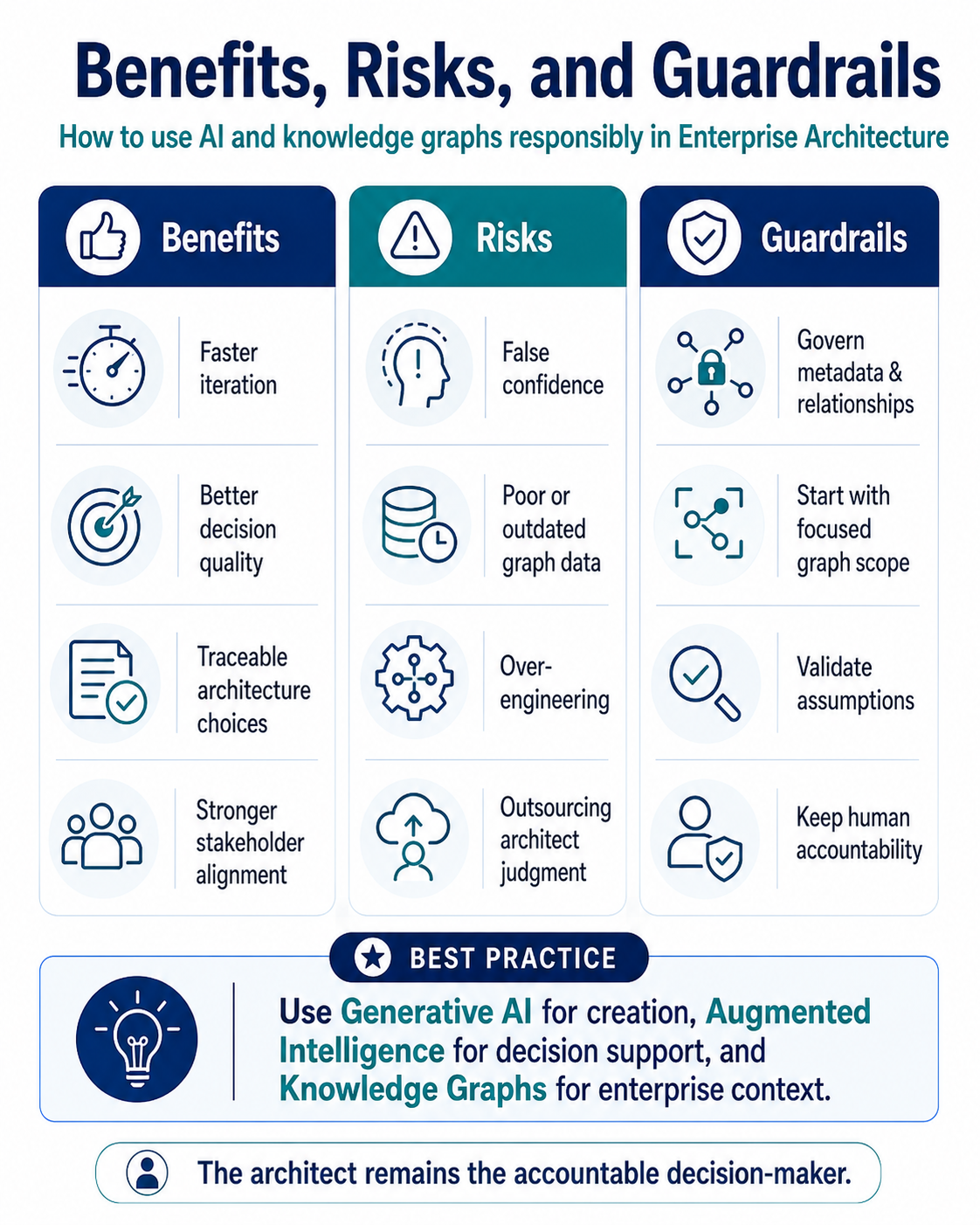
The benefits are compelling: faster iteration, better decision quality, traceable architecture choices, and stronger stakeholder alignment. But the risks are real: false confidence, outdated graph data, over-engineering, and outsourcing architect judgment to tools.
The solution is not to avoid AI. The solution is to govern it. Metadata, relationships, assumptions, scope, validation, and accountability must be explicit.
The RADIIC view
For transformation leaders, the point is not to make EA look more modern. The point is to make architecture more useful: more connected to business priorities, more transparent in its assumptions, and more traceable to the decisions that shape delivery.
That is where Transformation Enterprise Architecture becomes a strategic capability: it helps organizations decide what to change, why it matters, what depends on it, and how to sequence the work responsibly.
Bottom line: The next generation of Enterprise Architecture is not AI alone. It is AI plus graph data, governed by accountable architects who understand business value, enterprise context, and execution reality.